FORT CARNOT
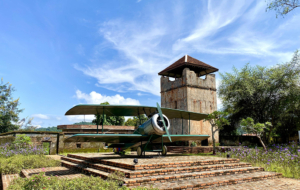
In the town of Houay Xay are the remains of Fort Carnot, an army fort built by French forces around 1893 following the acquisition of Laos into French Indochina in 1890. It takes around 10 minutes to reach Fort Carnot in a tuk tuk from the main street, although it is also a walkable distance. Due to no military action here at most times there were only a couple of French officers stationed at the Fort, supported by around 30 Vietnamese and Lao soliders. Although the French influence seems strong, there were never many French nationals posted in Laos. The French Indochina administration was based in Vietnam. After Laos independence from the French in 1954, the Royal Lao Army made use of the Fort until 1975 after which the Lao Army took over the complex and used it for army housing until recently. Fort Carnot is the best- preserved colonial military building in Laos. Along the south wall of Fort Carnot were the kitchen and the jail. The main east and west blocks were probably used for accommodation for the soldiers, and the smaller rooms on the west wing were officers quarters. In the west garrison block, you can see rifle racks on the walls and holes in the walls that would have been made by soldiers hanging up their mosquito nets.
THE GIBBON EXPERIENCE 2 – 3 days
Illegal logging, commercial cropping, excessive slash-and-burn practices, general population pressure on land and mismanagement have all combined to rapidly eradicate tropical forests. For this reason, the Gibbon Experience in Laos was given a mandate to think and act differently. Since 1996, they have ensured a sustainable future for the Bokeo forest. The Gibbon Experience currently provides full time jobs to over 120 people, and has schemes to encourage farmers away from slash and burn by assisting them to create irrigated fields, as well as tree planting schemes for reforestation.
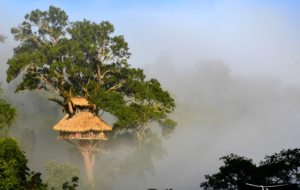
The Gibbon Experience includes hiking, zip-lining and staying in the canopy of the Nam Kan NPA in tree houses.
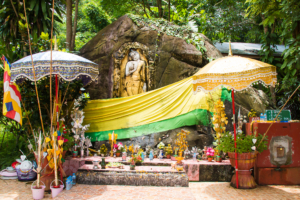
Pha Pra (Ancient Princess Sculpture)The Ancient Princess Sculpture has been discovered since the reign of the king Anouvong, this place is a natural combination with culture are seamlessly observing on the cliffs of this place is carved images on the rock, recounting that image evidence at the cliffs was carved by hand and swords of the King Anouvong to commemorate the souls of his daughter’s death here. in addition he buried some precious item into the rocks in the middle of the Mekong river and wrote an inscription: “The only eyes just feet” but unfortunately, These valuable things were dug and stolen by the thieves only the traces left.
How to get There: Take a Tuk Tuk, Taxi, motorbike or manage a tour from private travel agency from Huay Xai
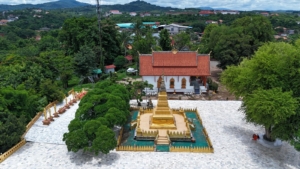
Souvanna Phakham Temple
On the stone inscription said that the former name” Vat Pha That Pak Hai “ is sacred all Buddhist people have respected. There was a legend of two brothers name “King Lava and Lavar were the sons of the King Lava Lavar wander along with his followers and hunters then got to an upland where was suitable for setting a trap catching for birds then the monks came across when the King Lava Lavar saw the faithfulness appeared so the monks were invited to be sprinkled water on the Mekong river bank after that the monks handled the wet robes to the king for drying then two brothers took a bath after bathing brothers picked up the monk’ robes while pulling the robes became a gold so they were excited by the incredibility then presented golden robe to the monks and followed the monks to camping site, making beds for the monks, preparing breakfast in the morning since then two brothers and followers listened for sermon till finishing they respected , as the monk patted the head three hairs stuck the hand from head gave them and the golden robe to the two brothers being told to make a monument for these things to be a place for all people to worship. Following monk’s instruction two brothers brought golden robes and silver to a smith to make golden, silver boats and golden, silver urns to store three hairs after that assigned followers to dig a hole on the hilltop where the trap was set as deep as the Mekong surface level to burry the golden, silver boats and golden, silver urns and built a stupa to cover that hole during the year 1022 stupa was named That Pak Hai then on their attendants settled in that area to to protect and look after the stupa since then the name That Pak Hai slightly changed to That Park Hai, Pha Kham (golden cliff) changed to Phar Kham (golden robe) according to an old people had recited that on the Buddhist day 15 kham (rising moon night) there was a shiny light on top of stupa all night. Right now, the place has been venerated along with the annual celebration of Buddhist believe especially on the Buddhist day 15 kham (rising day) in December on the same day of That Luang Stupa celebration in Vientiane capital. People will hold a festival to worship this stupa for three days enjoyably. Located in Tin That village, Huay Xai district, about 2.5 km south of the provincial capital.
– What to see and do: To venerate the stupa to get blessings, good luck for a trip during visit and enjoy view of Mekong river and Thailand.
– How to get There: all vehicles
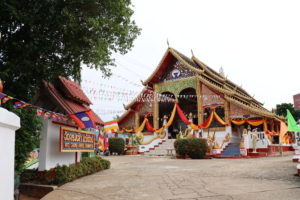
Chomkhao Manilat Temple
On that points we can see the landscape of Huay Xai urban and Chiang Khong (Thailand), thus it is easy accessible, this temple is old and sacred so most people have to respect, was built in 1880 it was researched that there are facilities provided enough for visitors with a plan to open to tourist. This temple is a highlight, a sacred altar of residents and tourists, recount that is the origin of the pillar on rock house model in the middle of the 15th century. Now has been burnt already, the inside of monastery still has images recounting the history of Buddha and Tao Hin ( turtle stone) to ask for good luck(as told that if one make the request and can raise Turtle stone means blessing that will be desirable), the door panels carved with a beautiful pictures of Sython Manola tales. Located in the major village Huay Xai neua, Huay Xai district, on a high mountain, or it can be said that it is a temple located in the center of the district.
– What to see and do: To see beautiful temple, study Buddhist matters, Lao tales and enjoy view of town and sunset.
– How to get There: by walking and all vehicle. Open every day free admission